
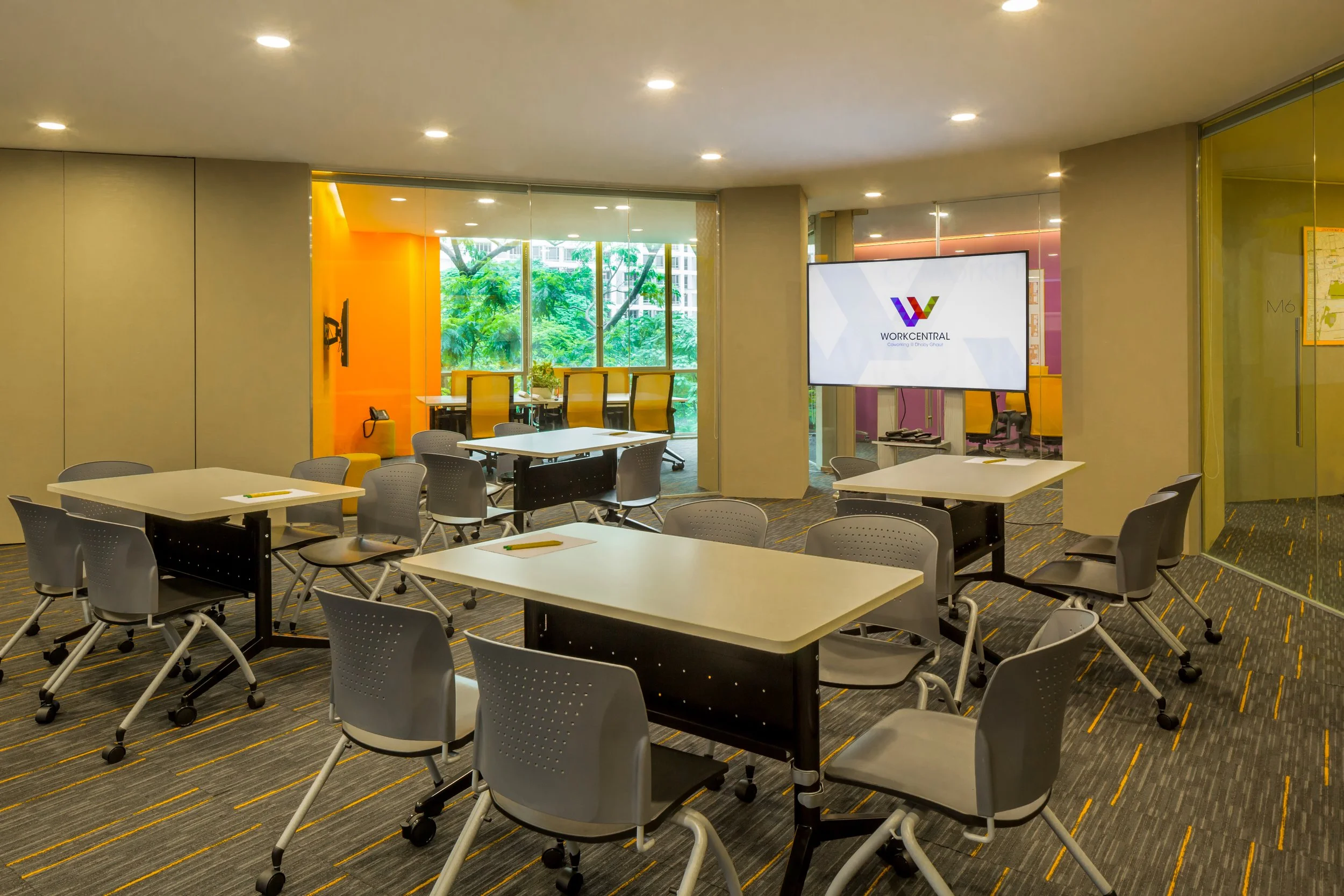
Finding a professional base in one of Asia's most expensive business cities should not drain the budget meant to grow your company. In 2026, the question for most business owners is no longer whether to leave the home office behind. It is how to make the right coworking space cost decision without walking into a contract that looks simple on the surface and quietly expensive once you are in it.
Singapore's flexible workspace market has matured faster than almost anywhere else in the region. Flexible workspaces now represent nearly 4% of Singapore's total office inventory, the highest penetration rate relative to market size in Asia-Pacific, reflecting the city-state's role as a regional business hub and the depth of demand from startups, SMEs, and multinational teams alike.
Coworking spaces for entrepreneurs now span every budget tier and working style. But more choice also means more variation in what a membership actually covers, and more ways to misread a price point.
This guide breaks down the full coworking space cost picture for 2026 by workspace type, by membership structure, and by what the headline price usually leaves out.
Navigating the 2026 Singapore Workspace Financial Landscape
Before comparing membership rates, it helps to understand why the Singapore workspace market is priced the way it is. The economics of the city's commercial real estate sector set the baseline that every coworking operator is working against.
The Real Cost of Traditional Commercial Real Estate in 2026
A 10-person team signs a traditional lease in a CBD building. Before the first employee sits down, the company has committed to two months of security deposit, a S$150 to S$200 per sq ft fit-out bill, and a reinstatement cost of S$15 to S$20 per sq ft at the end of the lease. That is easily S$300,000 to S$400,000 in sunk costs before a single day of rent begins.
With the example scenario, Singapore remains one of the most expensive places in Asia-Pacific to fit out an office. Average fit-out costs can exceed US$1,500 per square metre, driven by high labour costs, premium workplace specifications, and ongoing construction expenses. Businesses also need to budget for reinstatement works at the end of their lease, adding another major cost before they can hand the space back.
For a growing company with shifting headcount, that kind of capital commitment represents real risk. A coworking membership sidesteps the fit-out entirely, which is why even companies that could afford a traditional lease are increasingly choosing not to take one.
Making Sense of the Coworking Price Spectrum
Coworking space costs across the Singapore market in 2026 fall across a wide range depending on workspace type, location, and what is bundled into the membership. Here is where the broad market sits for office space in Singapore:
Hot desks: S$128 to S$750 per month depending on provider and district
Dedicated desks: S$400 to S$880 per month
Private office suites: S$500 to S$1,946+ per desk per month
Day passes: S$30 to S$90 per day
The lower end of each range typically reflects outer-district locations with minimal services. The upper end clusters around Marina Bay, Raffles Place, and similarly premium Central Business District (CBD) addresses. Most meaningful decisions happen in the space between those extremes.
Why "Cheap" Workspaces Can Drain Your Runway
Budget workspaces in outer districts and industrial zones solve one problem while quietly introducing others. Commute time for clients increases. The professional impression during in-person meetings weakens. For businesses that regularly host clients or position themselves against established competitors, the address and environment of a shared office space carry more commercial weight than the monthly savings.
These factors work best, especially when a freelance consultant books a $180/month hot desk in an industrial estate. The rent looks manageable. Then a client asks to meet. The client takes 45 minutes to get there, spends the whole meeting looking uncomfortable, and quietly moves to a competitor the following week. The S$180 saved ended up costing far more.
That calculus changes for a solo developer who never meets clients in person. It does not change for a consultancy, a financial advisory firm, or any business where the space reflects directly on how the brand is perceived.
Breaking Down Membership Tiers and What They Cost
Coworking memberships in Singapore are structured around four main tiers plus virtual office options. The right choice depends less on budget alone and more on how you actually use the space week to week.
Day Passes and Part-Time Access
Not every business needs a workspace every day. For occasional meetings, focused work, or a professional setting away from home, a day pass offers access only when it is needed, keeping costs aligned with actual usage.
Day passes range from S$30 at the accessible end to S$90 per day at premium CBD providers, with most sitting between S$50 and S$75. They offer good value for occasional visits but become less cost-effective once you are using the space more than twice a week. At that point, a monthly membership usually offers better value.
Hot Desk Memberships
Many people split their week between home, client sites, and shared workspaces. A hot desk membership provides a dependable place to work while allowing members to choose any available desk each time they visit.
Monthly hot desk memberships range from around S$230 at the accessible end to S$550 to S$750 at premium CBD locations. They are well suited to those who do not need a permanent workstation or personal storage but still want access to meeting rooms and workplace amenities.
One feature worth checking is access hours. Some memberships are limited to business hours, while others provide 24/7 entry, which can make a significant difference for those working outside a standard schedule.
Dedicated Desks
A consistent workstation can improve day-to-day efficiency without requiring a private office. Dedicated desks give members their own space to leave equipment set up while remaining part of a shared workplace.
Dedicated desk memberships run from S$400 to S$880 per month, depending on location and inclusions. Most include round-the-clock access and lockable storage, making them suitable for individuals or small teams that value consistency while still benefiting from the atmosphere and connections found in a coworking space. For businesses expecting to expand, this option often bridges the gap before moving into a private office.
Private Office Suites
Some organisations require an enclosed space for confidential discussions, secure documents, or a team that works closely together. A private office provides that level of separation while avoiding the financial commitment of a conventional lease.
Private office suites start from S$500 per desk per month at budget providers and climb to S$1,500 to S$1,946+ per desk per month at premium CBD operators. Members receive an enclosed workspace together with access to shared facilities, without taking on fit-out expenses or reinstatement costs at the end of the agreement. For companies comparing workspace options, this approach offers many of the advantages of a traditional office while keeping long-term commitments to a minimum.
Workcentral vs. The Market: A True Value Comparison
When evaluating coworking space cost, the headline membership rate is only one part of the picture. What matters is what the monthly fee actually buys, and how that compares to spending the same amount at a different provider.
Cutting Through Mega-Chain Surcharges
Large global coworking chains bring genuine advantages: international network access and consistent enterprise-grade finishes. They also carry pricing structures that reflect brand overhead.
Monthly hot desk memberships at Singapore's major international operators start at $265 to $520 per month before credits, add-ons, and access fees are factored in. Workcentral's 24/7 hot desk membership runs at $230 per month excluding GST, with 24/7 access, air conditioning until 10 pm including weekends and public holidays, and all core inclusions built into that single rate.
Transparent Baseline Inclusions vs. The Token Economy
The practical problem with token systems is that they make the real cost of a membership unpredictable. A business that holds four client meetings a month and uses a boardroom twice will consistently spend above the stated membership rate if the credit system is not structured to match that usage.
Workcentral operates on a fair-use basis rather than a credit economy. Meeting room access does not sit behind a monthly allowance that runs out mid-month. For businesses that need to budget accurately, that predictability has direct financial value beyond the headline rate comparison.
High-Value Central Fringe vs. Inconvenient Heartland Discounts
Imagine two founders comparing spaces. One pays S$180/month in an industrial estate near Tuas. The other pays $230/month in Dhoby Ghaut. The first founder saves $50 on rent and spends an extra 35 minutes each way commuting. Her clients push back on visiting. The S$50 saving disappeared in the first week.
Workcentral sits four minutes from Dhoby Ghaut MRT, connected by three rail lines and multiple bus routes. For businesses that value a central business district presence without the CBD premium, that position offers a genuinely useful middle ground: an Orchard-fringe address at a fraction of what Raffles Place or Marina Bay commands.
The Hidden Extras
The monthly membership rate is the number most people compare. It is also the number that most reliably understates the actual cost at budget or large-chain providers. Here is where the gap usually appears when possible situations arise.
Meeting Room Surcharges and Token Systems
A startup group books a two-hour investor presentation in a meeting room. His membership includes S$60 in monthly credits. The room costs S$45 per hour, which burns through his allowance in 80 minutes. The remaining 40 minutes come out of pocket at full rate. He budgeted S$550. He paid S$578.
Token or credit systems are the most common source of billing surprises in coworking. Providers issue a monthly allowance for meeting rooms, then charge full hourly rates once credits run out. For businesses that hold regular client presentations, investor calls, or internal planning sessions, that ceiling can be hit by the second week of the month.
Workcentral's fair-use model removes this variable entirely. Meeting room access is included in the base membership without a credit ceiling that triggers overage fees.
IT Infrastructure and Secure Wi-Fi Surcharges
A cybersecurity consultant joins a budget space. Two weeks in, she discovers the standard Wi-Fi is shared across 60 members with no traffic prioritisation. A secure, dedicated connection for client work costs S$80 extra per month. It was never mentioned at sign-up.
Some operators advertise high-speed connectivity as a standard inclusion but charge separately for dedicated bandwidth or secure network configurations. These are not optional extras for most modern businesses. Workcentral includes commercial enterprise-grade Wi-Fi in every membership tier, with cable internet available for Suite members who need wired connections for added stability.
Printing, Mail, and Administrative Tools
Printing costs, mail handling fees, security deposits, and scanning charges tend to appear as small numbers on individual invoices and larger numbers on an annual tally. A provider that charges S$0.20 per page for printing, S$20 per month for mail handling, and S$15 per parcel scan will add meaningfully to a supposedly fixed monthly cost.
Workcentral includes a business address with mail handling as standard across all membership tiers from Hot Desk upward, with no per-item charges for standard mail receipt. For businesses that regularly receive courier deliveries or government correspondence, that inclusion eliminates a category of cost that budget providers routinely pass through as extras. If you are also considering a virtual office arrangement, the same mail-handling service is available from S$20 per month without a physical desk.
Balancing Cost and Value: Maximising Your ROI
The right coworking space is not necessarily the cheapest one. It is the one where the total cost of membership, including what it enables, produces the best return on the money spent. Three factors shape that calculation.
Location Economics: CBD vs. Central Fringe
Prime CBD addresses in Raffles Place and Marina Bay carry rent premiums that reflect the land value of those locations. For businesses that need to impress institutional clients or financial sector partners regularly, that premium can be justified by the business it generates. For most SMEs and growing teams, a central fringe location near Dhoby Ghaut or Orchard offers the same MRT accessibility and professional address quality at a significantly lower monthly cost.
The prestige differential is measurable in rent and far harder to measure in actual business outcomes. For most coworking spaces in Singapore, the central fringe tier represents the strongest cost-to-credibility ratio available.
Offloading the Mental Load of Office Management
A solo business owner spent two hours a week managing her previous office: chasing the cleaning contractor, dealing with the internet provider, restocking the pantry, and waiting for the electrician. When she moved to a coworking space, those two hours went back to client work. Across a year, that is more than 100 hours returned to revenue-generating activity.
All-inclusive coworking memberships fold utilities, cleaning, security, reception support, and pantry access into a single monthly fee. The time and attention that would otherwise go to managing those separately stays with the business.
When evaluating coworking space cost, factor in the equivalent cost of sourcing and managing those services independently. For a small team, the savings in contractor fees, utility deposits, and management time can easily bridge the gap between a budget option and a well-run all-inclusive space.
Community Dividends: The Built-In Networking Ecosystem
Workers in Singapore already spend 64% of their working hours in the office per week, which is 13% more than their global counterparts. That means the environment people work in has a direct and consistent effect on how they perform, who they meet, and what opportunities become available to them.
The financial return of a workspace does not stop at the desk. Proximity to other professionals creates networking events, introductions, and referrals that carry real commercial value. A potential client, a useful service provider, or a future hire might already be working two desks over. The right community accelerates business growth in ways that a home office or an isolated industrial unit simply cannot replicate.
Find a Space That Works as Hard as You Do
The true coworking space cost is not just what you pay each month. It is what you get back for it, in productivity, in professional credibility, and in capital that stays in the business rather than going into a deposit or a fit-out.
Workcentral is built around that idea. Transparent pricing, a central Dhoby Ghaut address, enterprise-grade infrastructure, and no token economy sitting between you and the facilities you need. Whether you are starting with a day pass to test the environment or ready to move a team into a private suite, the membership structure adjusts to where the business actually is.
Explore Workcentral’s membership plans today.
Frequently Asked Questions about Coworking Space Cost in Singapore
Common questions about coworking space cost in Singapore, answered directly.
What is the average coworking space cost in Singapore for a hot desk in 2026?
In 2026, hot desk memberships in Singapore typically range from S$230 to S$550 per month depending on location and included services. Providers in the Raffles Place and Marina Bay area sit at the higher end, while well-located central fringe spaces like Workcentral offer full 24/7 access from S$230 per month excluding GST. Day passes for occasional use run from S$30 to S$90 depending on the provider.
Why do coworking space costs vary so much across Singapore?
Pricing is driven by two main factors: the real estate value of the location and the depth of services included in the membership. A space in Raffles Place carries a land cost premium that filters through to the membership rate. A space that bundles 24/7 access, enterprise-grade Wi-Fi, reception support, and meeting rooms into a single fee will cost more than one that charges separately for each of those services. The most useful comparison is total monthly spend against total inclusions, not just the headline rate.
Are utilities, Wi-Fi, and cleaning services included in the baseline coworking space cost?
For reputable operators, yes. A major advantage of flexible workspaces is their all-inclusive structure. At Workcentral, the monthly membership covers commercial enterprise-grade Wi-Fi, daily office maintenance, electricity, utility services, and pantry access, keeping monthly costs predictable without separate service contracts to manage.
What are the typical upfront costs when signing up for a coworking membership?
Unlike traditional commercial leases that require substantial fit-out investment and two to three months of security deposit, coworking spaces require minimal upfront capital. Most providers ask for a refundable security deposit equivalent to one to two months of the membership fee alongside the first month's payment. There are no reinstatement liabilities and no fit-out costs to absorb before the space becomes usable.
Can a team change or scale its membership plan if headcount changes mid-contract?
Yes. Flexibility is one of the core advantages of the coworking model over a traditional lease. Most providers allow members to move between membership tiers as the team grows or contracts, transitioning from a hot desk to a dedicated desk or into a private office suite without penalty. At Workcentral, memberships are structured to scale alongside the business, which means a company does not have to restart the search for space every time its requirements change.
